 Posted by:
In a mansion high in the hills of Madrid lived Alejandro Doval, a young, charismatic, and wealthy businessman who rarely heard the word “no.”
He owned companies, cars, gold watches… but he didn’t have anything that money couldn’t buy
After his public breakup with his fiancée, Alejandro became suspicious and cold. He didn’t believe in anyone’s goodness; he thought everyone was after his strength.
It was then that he hired a domestic servant: Lúcia Herrera, a twenty-two-year-old girl, shy, polite, with honey-colored eyes and a way of speaking that seemed like a caress to the soul.
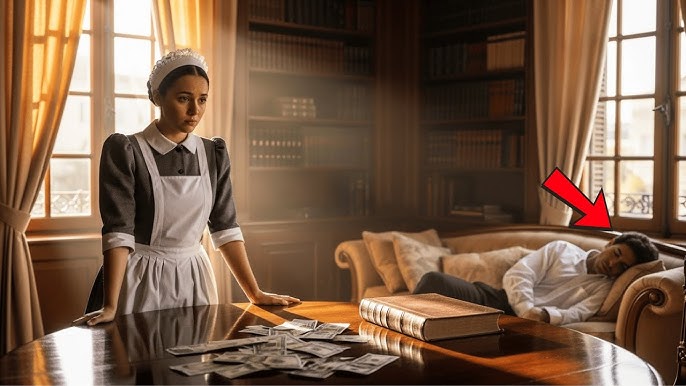
Lúcía had come to the city from a small town in the countryside. She had lost her parents and desperately needed the job. Everything about the house seemed attractive to her: the high ceilings, the thick carpets, the priceless paintings. But she didn’t touch anything more than necessary. She only cleaned, milked, and always left with a discreet smile.
At first, Alejandro barely liked her. But one night, while he was sitting alone in front of the fireplace, he heard her voice softly coming from the hallway. It was a typical song, the kind grandmothers hummed as they lulled themselves to sleep.
Her trembling voice sounded strangely comforting. That night he slept better than he had in months.
Days later, Alejandro’s friend commented to him, laughing:
“You should be careful with your maid.” Sometimes sweet faces hide behind clues.
Alejandro, with his wounded pride and chronic mistrust, decided to put her to the test.
One night, he pretended to be asleep on the living room sofa. He had left his most expensive watch on the table, next to his open wallet and a pile of money.
Lucia was supposed to come in to clean later, as she did every night.
It was almost 10 o’clock when the door opened suddenly. Lucia entered barefoot, with her hair tied back and a small bunk in her hand. She moved slowly, respectfully, as if afraid of waking the ghosts of the house.
Alejandro narrowed his eyes, controlling his breathing to appear asleep. He expected to see something… some sign of interest in the money, a covetous look.
But what he saw left him breathless.
Lucia didn’t approach the money.
Instead, she leaned over him and, with a sad expression on her face, covered his shoulders with her hands.
Then she sighed, as if she were just a little sad:
“I wish I weren’t alone…”
She stood there looking at him for a few seconds. Then she took the gold watch, but not to steal it, but to polish it with her handkerchief, as if it were someone else’s treasure that she needed to protect.
Afterward, she placed it in exactly the same place.
Before leaving the room, she stopped again and left something small on the table: a dried flower, a daisy, a folded sheet of paper.
Alejandro, unable to resist his curiosity, waited for her to leave and took the pot.
On it, in shaky handwriting, it read:
“Sometimes, those who have everything need something as simple as being seen with kindness.”

That night, Alejandro couldn’t sleep.
The phrase haunted him like an echo, wounding and calming him at the same time.
The next day, he watched her from his study while she cleaned the vegetables. There was something about her way of moving, her silence, that he couldn’t possibly see as ambition.
It was humility. It was honesty, almost painful.
Days passed, and the ordeal became an obsession. He pretended to go back to sleep, and once again Lucia repeated the same ritual: she covered him up, turned off the lamp, and said something kind before leaving.
One night, if he could resist any longer, he opened his eyes just as she was about to leave.
“Why are you doing that?” he asked in a stony voice.
Lucia started and dropped the litter.
“Mr. Dval! I… thought you were sleeping…”
“I was pretending,” he admitted, embarrassed. “I wanted to see what you really were.”
Her eyes filled with embarrassment.
“Did you test me?” she asked in a low voice.
He nodded.
“I thought everyone wanted something from me. But you… you just leave flowers and kindness. Why?”
Lucia lowered her gaze.
“Because someone, once, told me that when a person closes themselves off from their wealth, they end up living surrounded by things, but empty of people. And you… you seem so alone.”
Alejandro, I don’t know what to say. For years, no one had spoken to him with such sincerity.
That night, for the first time, they sat down to talk. Lucia told him about her village, her grandmother, the smell of freshly made land.
He told her about his father, his expectations, his fear that she would want him just for his money.
They talked until dawn.
As the weeks passed, something changed in the morning. The lights, once cold and white, seemed warmer. The silence no longer weighed so heavily.
Alejandro began to smile. He invited Lucia over for breakfast, read her the emails that were bothering him, and asked her simple questions like, “Do you like this song?”
And once he said it, they both knew something was growing between them.
It wasn’t immediate romantic love. It was respect, an invisible connection that came from the most sincere kindness.
Gift baskets
One afternoon, Alejandro discovered that the back garden was full of small dried daisies. Lucia picked them and let them dry in the sun.
“Why daisies?” he asked.
She smiled.
“Because even the simplest flowers can make someone who already has everything smile.”
However, not everyone shared this newly found peace.
One of Alexander’s associates, envious, began to spread rumors: that Lucia was corrupting him, that she wanted him to take a share of his inheritance.
Alexander, weak and still unconfident, refused to be present.
And that presence was enough to destroy something.
One morning, Lucia didn’t return.
She left only the letter on the table where she usually placed the flowers.
“Don’t worry about me, Mr. D’val. I appreciate every word we shared. But I’d rather leave before becoming another shadow in your history. Say goodbye. —L.”
Alejandro searched for her for weeks, without success.
Until one day, months later, in a small town in the port, he saw a bakery with a sign that read: “Lucia’s Daisies.”
He entered.
She was behind the counter, doing her best, with the same shy smile.
When he saw it, he dropped the rolling pin.
“I thought I’d never see her again,” he said, without a mask, without pride.
“Me too,” she replied.
He approached, took a dried daisy from his pocket, identical to the ones she left him every night, and placed it on the counter.
“You never stole anything from me, Lucia… but you took away my fear of leaving.”
She smiled, with tears in her eyes.
And this time, Alejandro didn’t pretend to sleep.
He just lay there, awake, staring at the only person who had managed to truly wake him up.