 Posted by: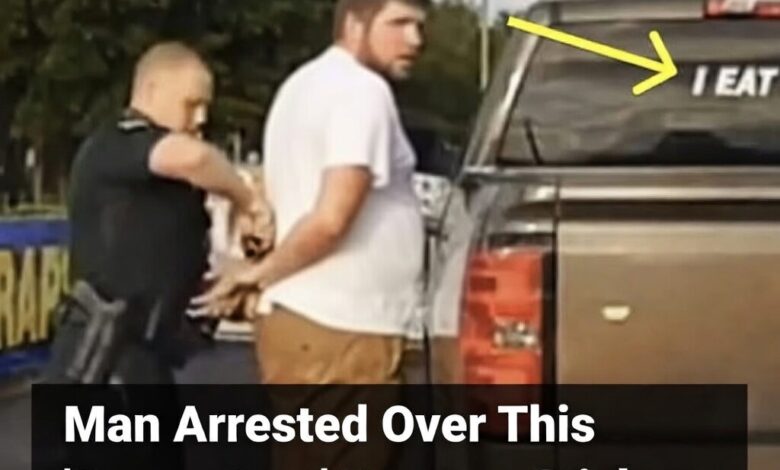
When Dillon Shane Webb pulled his vehicle onto a standard Florida roadway, he likely expected nothing more than a routine, entirely forgettable daily commute. He certainly did not anticipate that a simple, albeit exceptionally crude, custom bumper sticker affixed to his rear window would ignite a high-stakes confrontation with local law enforcement, leading to handcuffs, a jail cell, and a dramatic federal court battle. The entire explosive incident serves as a stark, modern reminder of how thin and volatile the line can be between what the general public considers offensive in a shared space and what is actually deemed illegal under the supreme law of the land. In this landmark clash, the law, as it turns out, proved to be far more protective of individual expression than the arresting officers or the average outraged bystander ever realized.
The deputy who initiated the traffic stop acted on the immediate, firm assumption that the sheer vulgarity of Webb’s sticker constituted a clear-cut case of disorderly conduct. From the officer’s perspective, the text on the vehicle was an obscene, public display that warranted immediate physical intervention, a forced removal of the vinyl lettering, and criminal charges. However, this roadside interpretation of order completely ignored the deep legal reality of the American legal system. The First Amendment of the United States Constitution provides a massive, incredibly robust shield for individual speech, ensuring that the government cannot easily weaponize the penal code to silence expressions that are intentionally provocative, exceptionally rude, or deeply offensive to the average citizen passing by.
To truly understand why this specific traffic stop collapsed so spectacularly in the legal arena, one must look at the remarkably high threshold required to legally classify speech as obscenity in the United States. For decades, the highest courts in the country have consistently and explicitly ruled that merely being offended, shocked, or disgusted is not a valid legal basis for the government to silence an individual or restrict their expression. The legal definition of obscenity does not apply to simple vulgarities or crude humor displayed on the back of a truck. For any form of speech or writing to cross the line into criminal territory, it must typically involve true threats of imminent physical harm, direct incitement to immediate lawless violence, or meet a highly specific, three-part legal standard for hard-core sexual obscenity that is virtually never triggered by mere words printed on a piece of vinyl. Webb’s case immediately transformed into a textbook example of unchecked police discretion aggressively clashing with bedrock constitutional rights.
Recognizing the massive constitutional blunder that had just occurred, the state prosecutors dropped the criminal charges against Webb almost as quickly as the paperwork was filed. The broader legal system instantly recognized that while the bumper sticker was undoubtedly in incredibly poor taste and lacked any traditional artistic merit, it fell completely short of the strict criteria required to constitute a public disturbance, a breach of the peace, or a criminal act. The arrest was exposed as a glaring, dangerous example of law enforcement overreach, vividly illustrating the societal peril that arises when individual police officers are permitted to act as the ultimate arbiters of taste, decency, or morality on the side of the highway.
Rather than quietly walking away with his freedom and letting the frustrating matter rest, Webb made the calculated decision to fight back against the system. The subsequent federal civil rights lawsuit he filed was not merely an attempt to seek financial compensation for the humiliation, trauma, and inconvenience of an unlawful arrest; it was a necessary, targeted challenge to the boundaries of government authority. When public officials use the badge and the gun to suppress an individual’s speech simply because they find the content personally distasteful or culturally inappropriate, they actively erode the core freedoms that the Constitution was explicitly designed to safeguard. By aggressively taking the case all the way to a federal courtroom, Webb forced a vital national conversation regarding the strict limits of police power and the absolute necessity of protecting highly unpopular, abrasive speech from state censorship.
This historic case serves as an essential, timeless lesson for every single citizen living in a free society: the sacred right to speak freely is absolutely not reserved exclusively for those who choose to be polite, agreeable, or conventional. It is a fundamental, foundational liberty that intentionally includes the right to be crude, the right to be intentionally provocative, and the right to fiercely express viewpoints that the vast majority of the population might find thoroughly repulsive or socially unacceptable. The federal court’s ultimate decision to side with the driver and uphold the protection of offensive speech reinforces a bedrock principle of a constitutional democracy: the ruling government cannot punish you, detain you, or strip away your freedom simply because they do not like the words you choose to utter or display.
Ultimately, the true legal debate in this case was never about whether the bumper sticker was tasteful, mature, or polite. It clearly and undeniably was none of those things. The real, high-stakes question centered entirely on who holds the ultimate power to decide when human speech becomes punishable by the state. In this explosive instance, the American legal system provided a resounding, unshakeable answer: that power does not belong to the government, and it most certainly does not belong to an angry deputy standing on the shoulder of a highway. It stands as a monumental victory for the enduring principle that, in a genuinely free society, citizens must tolerate the deeply offensive to ensure that the most essential liberties remain entirely protected from tyranny.