 Posted by: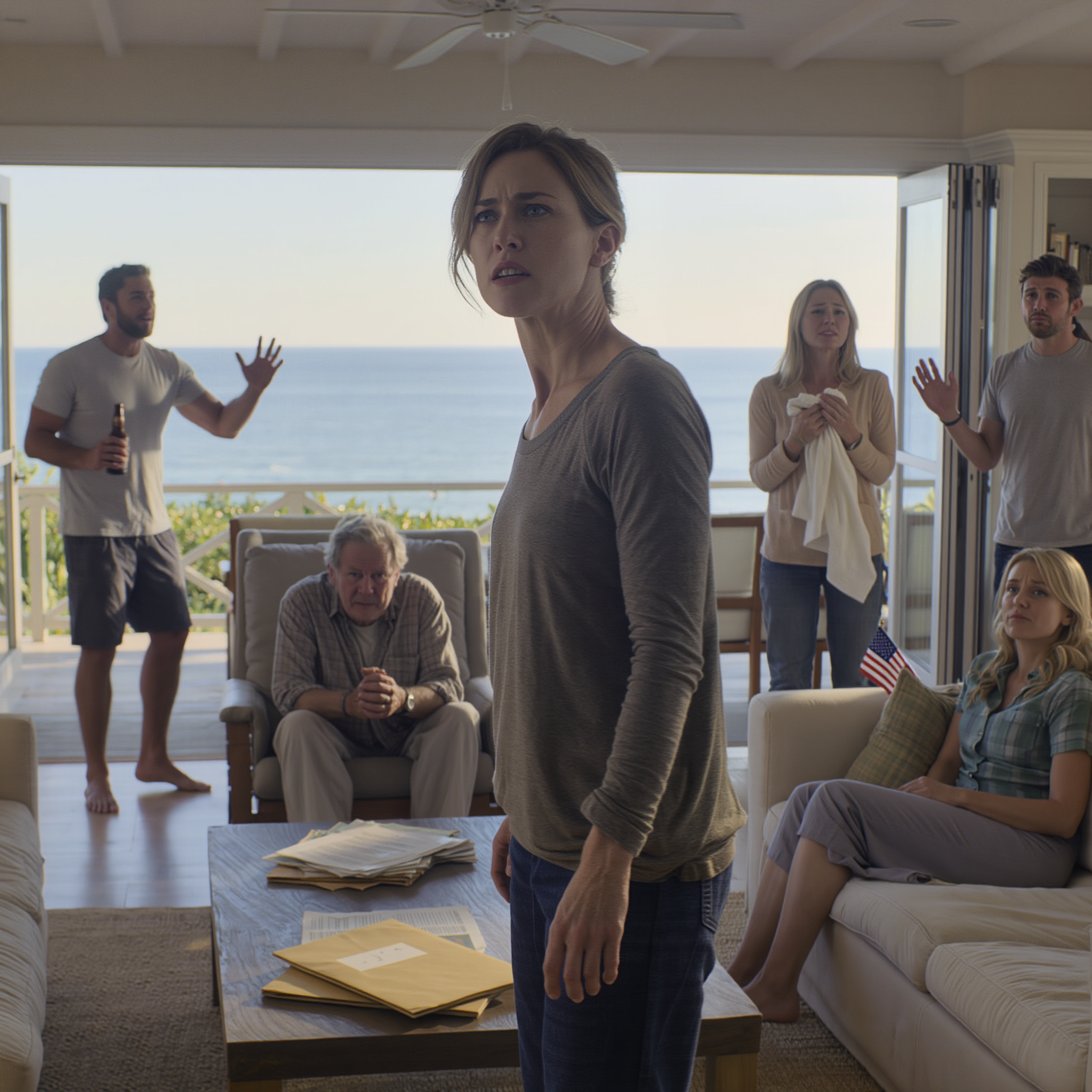
“This is my house. Get out.”
That’s what my brother‑in‑law yelled at my father in the middle of the $425,000 seaside house I’d bought as a surprise for my parents’ fiftieth wedding anniversary. Dad’s shoulders folded in on themselves, his hand still resting on the back of the chair he’d just been told to vacate. Behind him, the stainless‑steel fridge hummed quietly, a faded American flag magnet holding up his handwritten grocery list. On the counter, a sweating glass of iced tea left a ring beside the celebration cake I’d picked up that morning from a bakery off Highway 1. My mother’s tears soaked the lemon‑printed dish towel she gripped like a white flag. Somewhere in the background, Sinatra crooned from the little Bluetooth speaker she’d brought from their apartment, his voice completely at odds with the scene.
I stood in the doorway, still holding the cake box with one hand, the new house keys digging into my palm from the other. My sister Olivia laughed like chaos was her favorite playlist, sprawled on the couch with her phone in her hand and her flip‑flops kicked off. Mark—barefoot, beer in hand—had planted himself between my dad and the view like he owned both.
I didn’t shout. I didn’t move. I just smiled once, slow and calm, and let my gaze slide from my father’s trembling hands to the American flag magnet on the fridge.
They thought they’d taken everything.
They had no idea what I’d kept.
Two weeks earlier, everything in that house had felt lighter.
The first time I unlocked the door, the air smelled like ocean salt, fresh paint, and new beginnings. The real estate agent had left a little welcome basket on the counter—store‑brand cookies, a brochure about hurricane shutters, a coupon for a local diner with a flag logo in the corner. Sunlight spilled through the big windows and moved across the hardwood like it had nowhere better to be.
The little blue house by the water was modest by millionaire standards, but to me it was everything: three bedrooms, two and a half baths, a wraparound deck with a partial view of the Atlantic, and enough room for my parents to finally stretch out without worrying about rent increases. I’d spent months hunting for something exactly like it—something quiet, paid‑off, and far enough away from their cramped apartment that it felt like a different life.
I’d scrolled through listing sites at midnight with burning eyes, highlighted HOA bylaws on my lunch break, and driven out here on more Saturdays than I wanted to admit, coffee in hand, hoping the next place wouldn’t smell like mildew and regret. When I walked into this one and saw my reflection in the sliding glass door—tired thirty‑four‑year‑old woman in a wrinkled blazer, under‑eye circles courtesy of tech deployments and late‑night side gigs—I saw more than myself.
I saw my parents in every corner of that house.
My dad on the deck, legs crossed, a fishing magazine open in his lap. My mom in the kitchen, a Sinatra playlist humming on her phone, that same lemon‑printed dish towel draped over the oven handle. I saw holidays that didn’t end with them driving back to an apartment that always felt one late notice away from disappearing.
“This is it,” I whispered to the empty room. “This is theirs.”
The closing took forty‑five minutes and a decade off my life expectancy. The title officer slid a stack of papers across the table, and I signed my name over and over until the ink on the $425,000 line looked unreal. I’d spent years saving for that number. No vacations, no new car, no random splurges—just my salary, my freelance checks, and the stubborn belief that one day I’d buy my parents one thing no landlord or bank could dangle over their heads.
We didn’t put the house in my name or theirs.
Instead, my attorney and I built something boring and bulletproof: the Harborview Trust. Harborview Trust held title to the property. My parents—Sam and Ruth Lawson—were named as lifetime beneficiaries. I was the trustee. The documents spelled it out in clear, simple language: they had exclusive occupancy for as long as they lived, and my job was to protect their peace.
I made myself a quiet promise while I signed.
If anyone ever tried to turn their peace into profit, I wouldn’t play nice this time.
Growing up, I’d watched fear move into our lives one overdue notice at a time. I remember Mom at the kitchen table, smoothing out past‑due rent statements with shaking hands. I remember Dad coming home from the plant with grease on his boots and exhaustion in his bones, promising he’d pick up more hours, as if there were more hours to take.
I was ten when I learned to say, “It’ll be fine,” while memorizing the eviction notices taped to the door. Sixteen when I slid grocery money into Mom’s purse and pretended I’d found it on the sidewalk. Twenty‑three when I paid their electric bill “just this once.” Twenty‑eight when I started paying Olivia’s credit cards “until Mark’s new job kicks in.”
Every bailout felt like control. It wasn’t. It was just enabling chaos wrapped in love and tied with guilt.
So when I wired the final payment for the house, alone in my apartment one night while the code on my laptop blurred from exhaustion, something inside me shifted. I wasn’t just buying my parents a place to live. I was buying them one corner of this world that couldn’t be repossessed every time someone else made a mess.
I wanted them to have one thing that couldn’t be taken.
When I called and asked if they’d go on a weekend drive with me, Mom assumed I’d made dinner reservations somewhere fancy.
“You didn’t have to do all that, Bella,” she said, wiping her hands on that lemon‑printed dish towel. “We’re fine with burgers on the grill.”
Dad packed his fishing gear anyway. “Maybe there’ll be a little pond,” he said with a grin. “You never know.”
They had no idea.
The drive out to the coast took a little over an hour. The city fell away behind us, replaced by flat stretches of marsh grass and flags hanging off porch rails and pickup trucks. Mom pointed at every patriotically painted mailbox like it was a tourist attraction. Dad hummed along to classic rock on the radio, fingers drumming the steering wheel.
When we turned onto Harborview Lane and the blue house came into view, Mom went quiet mid‑sentence.
“Whose place is that?” she asked, pressing her hand to her chest.
“Come find out,” I said, easing into the driveway.
The real estate agent had propped a little “Welcome Home” sign by the front step. The new house keys hung from a hook beside it, the tiny American flag keychain catching the sun. I picked them up and weighed them in my palm for a second before dropping them into Dad’s hand.
“Happy fiftieth,” I said. “It’s yours. Every part of it. No landlord. No bank. No ‘thirty days to vacate’ notices. Just you two and the ocean.”
He stared down at the keys like they might disappear if he blinked. “Bella…” he started, voice cracking. “We can’t—this is too much—”
Mom was already crying. She stepped into the kitchen, opened a cabinet, and breathed in.
“It smells like lemons,” she whispered. “Not stress. Not burnt toast. Lemons.”
Dad ran his hand along the banister like it was something sacred. He opened the sliding glass doors and stepped out onto the deck, the Atlantic stretching out in front of him in a long silver line. For the first time in years, his shoulders dropped away from his ears.
We ended up side by side in white Adirondack chairs, watching the sky melt from pink to gold to deepening blue. The neighbor’s American flag flapped lazily in the warm wind. Mom kept wiping tears away with her dish towel and laughing at herself.
“This is really ours?” she asked again.
“It’s yours,” I said. “I set it up so no one can ever make you leave. Harborview Trust. You and Dad are the lifetime beneficiaries. My job is just to protect it. To protect you.”
Dad swallowed hard. “You remember when the landlord changed the locks while we were at work?” he said quietly. “You were, what, eight? We came home and—”
“And all our stuff was in trash bags,” I finished for him.
He nodded, eyes on the horizon. “I promised your mom that day I’d never let anyone do that to us again. Took me forty years to make good on it.”
“You didn’t break the promise,” I said. “Life did. I’m just… finishing the paperwork.”
We sat there until the first stars came out. Before we left that night, I slipped into the kitchen, opened the top drawer, and pulled out a blank index card. I wrote one line and slid it under Mom’s folded lemon‑printed dish towel.
One quiet place no one can take from you.
It was just a sentence on cheap paper, but it felt like a vow.
Driving back to the city, I kept glancing at the glow of the house in the rearview mirror. For the first time in years, I believed peace might finally have an address.
Peace doesn’t last long in families like mine.
Three days later, Olivia saw Dad’s Facebook post.
He’d uploaded a slightly crooked photo of the deck at sunset—his socked feet propped on the rail, a corner of the American flag next door in the frame, the caption simple: “Blessed beyond words.”
Mom texted me a screenshot with three crying emojis and a heart. I smiled at my desk and went back to my product deployment, happy to picture them out there breathing ocean air instead of city exhaust.
Somewhere else, a different group chat lit up.
“New place?” Olivia had typed. “Whose?”
“Bella did something crazy,” Mom replied. “She bought this little house by the water. For us.”
There was a gap—those gray “typing” bubbles popping up and disappearing. Then: “Send pics.”
Mom, being Mom, sent everything. The kitchen. The living room. The deck. The view from the upstairs bedroom. The tiny flag keychain on the hook by the door. The lemon towel folded neatly in the drawer after she’d found my note and pressed it to her heart.
“Wow,” Olivia wrote back. “Family beach house. So happy for us.”
For us.
I didn’t see that exchange until later. If I had, maybe the quiet in my chest wouldn’t have felt so much like safety.
By the fifth day, my phone buzzed during a meeting. A notification from social media: “@OliviaLawson tagged you in a photo.”
I opened it without thinking.
Same deck. Different scene.
Olivia’s kids were sprawled across my dad’s chair, one of them holding his fishing hat. Mark’s bare feet were propped on the railing where Dad’s had been. An open beer sat on the armrest. The caption read: “Home sweet home. Huge thanks to baby sis for making our beach dreams come true. #FamilyHouse #Blessed #BeachLife.”
The words “home sweet home” blurred.
I texted her. “You guys visiting?”
“Helping Mom and Dad get settled,” she replied. “Place is big. We’ll see you this weekend?”
Something in my stomach twisted. I told myself I was overreacting. That I’d set this up in a trust for a reason. That grown adults wouldn’t try the same old tricks now that there was actual paperwork.
I should have known better.
When I pulled into the driveway that Saturday, the first thing I saw was Olivia’s black SUV parked half on the lawn, half in the gravel, like it had just crash‑landed there and decided to stay. The back hatch gaped open, half‑unpacked boxes spilling out, a tangle of towels and toys jammed together.
A cartoon blared from inside the house, loud and tinny. The front door stood wide open, curtains breathing in and out with the breeze like the house itself was anxious.
Something in my chest tightened before I even stepped out of the car.
I grabbed the cake box from the passenger seat—the same one I’d planned to surprise them with—and walked up the path. The tiny American flag keychain swung from my fingers, warm from where it had pressed into my palm on the drive.
Inside, the air smelled different. Not like paint and ocean and lemons. Like grease. Beer. A sticky sweetness from spilled sports drinks.
Mom stood at the sink, her back hunched, that lemon‑printed dish towel twisted between her fists. Her eyes were red and puffy. Dad sat in a chair by the window, fingers trembling on the armrest, staring at the floor like it might tell him what to do.
“Mom?” I said quietly.
She jumped, then whispered my name like it hurt. “Bella.”
Before I could cross the room, a man’s voice floated in from the hallway.
“Upstairs for us,” he called. “Kids want the room with the ocean view. Put Mom and Dad downstairs where they don’t have to do the stairs.”
I turned the corner.
Mark stood barefoot in the living room, a beer in his hand, his body planted in front of my father like a barrier. Olivia was on the couch, scrolling on her phone, her flip‑flops dangling off her toes. Boxes marked “MARK’S CLOTHES” and “KIDS’ TOYS” were stacked by the stairs.
Mom whispered my name again, this time like a warning and a prayer.
Mark didn’t even look at me. “Family home, right?” he said to Dad. “We’re just settling in. We’ll keep the place running. Win‑win.”
Olivia finally glanced up. “Relax, Bella,” she said, laughing. “You know Dad’s bad with stairs. We’re helping. We’ll handle things here.”
The words “family home” hit like a punch.
“You told them?” I asked Mom, my voice thin.
She shook her head fast, eyes glassy. “They saw the pictures your dad posted,” she said. “I tried not to—but Olivia kept asking. I didn’t think they’d…”
Dad couldn’t meet my eyes. “She said it was fine,” he muttered. “Just for a few days.”
A few days. That was always how the trouble started.
Olivia’s kids ran past, trailing sand across the floors I’d scrubbed myself. The dog darted after them, nails clicking on the wood. Mark raised his voice over the cartoon.
“Peak season’s coming,” he said. “We could rent this place easy. I already made a listing. Gotta make the house pay for itself, right?”
I stared at him. “You did what?”
He grinned, finally turning fully toward me. “Don’t be weird, Bella. It’s family money. Family house. You always act like you’re the only one who understands numbers.”
Mom tried to speak, her voice paper thin. “They just need a few days,” she said. “They’ll help with the mortgage.”
“There is no mortgage,” I said. My throat felt dry. “The house is paid off.”
Mark shrugged. “Even better. Pure profit.”
Every part of me wanted to scream. To pull every box out onto the lawn. To call the police and have them physically removed. To remind everyone in the room whose name sat on the trust documents.
Instead, I set the cake box on the counter.
“I’ll be back tomorrow,” I said quietly.
Olivia rolled her eyes. “You drove all the way out here just to drop off a cake and drama?” she said. “You’re exhausting.”
Mark lifted his beer like a toast. “Bring more of that sparkling cider when you come,” he said. “That stuff’s good.”
Outside, the ocean shimmered so bright it hurt to look at. The neighbor’s flag snapped in the wind like it was tired too.
I walked back to my car and slid into the driver’s seat. My hands shook as I gripped the steering wheel until my knuckles went white.
They thought I was leaving to cool off.
They didn’t know I was going home to plan their eviction—legally, quietly, permanently.
Anger makes mistakes.
Precision does not.
By the time I pulled into my apartment’s parking lot, the shaking had stopped. I carried the cake upstairs, shoved it into the fridge without looking at it, and went straight to my desk.
I opened my laptop and clicked on the folder labeled “Harborview.” Inside, subfolders waited like tools: Deed. Trust. HOA. Insurance. Notes. Screenshots.
Each file felt like a small weight I could finally put down in the right place.
First, I pulled up the recorded deed. Harborview Trust listed as owner. No co‑owners. No “et al.” No Olivia, no Mark. Just Harborview Trust.
Next, the trust instrument. I reread the paragraph my attorney had made me repeat back to him: “Trustee shall have the duty to protect the Beneficiaries’ exclusive right to occupy the property and to remove any person or condition that interferes with their peaceful enjoyment.”
Exclusive. Peaceful. Remove.
Then I opened the listing.
Mark hadn’t lied. There it was on my screen—a glossy profile for “Entire Oceanfront Cottage – Sleeps 8,” complete with photos I’d taken myself before my parents moved in. My words, copied from an email to the real estate agent: “Perfect for slow mornings and long sunsets with family.” Only now there was a price tag: $495 per night.
Ten weekends blocked off. Eleven confirmed bookings. Estimated payout over the next three months: $19,500.
Every cent routed to Mark’s account.
My stomach knotted, but my hands stayed steady as I took screenshots. Listing page. Booking calendar. Payout details. I saved them all in a new subfolder labeled “Violations.”
Then I opened the group chat Mom had forwarded me once she realized things were spiraling.
Olivia: “This place is a goldmine.”
Unknown number: “Think Bella will be cool with it?”
Olivia: “She never says no if Mom cries.”
Mark: “Peak season, baby. Free money.”
I copied the conversation, pasted it into a document, cleaned up the formatting, and dropped it into the same folder.
Next up: the HOA rules. I scrolled through digital pages about mailbox heights and yard décor until I found the section I’d vaguely remembered.
“No short‑term rentals permitted. Minimum lease term thirty (30) consecutive days. Violations subject to fines, enforcement action, and possible legal proceedings.”
I took another screenshot and saved it.
Then I picked up my phone and dialed the HOA office number listed at the bottom of the PDF. I expected voicemail.
A woman answered on the third ring, sounding like she’d rather be anywhere else.
“Harborview Shores HOA,” she said.
“Hi,” I said. “My name is Bella Lawson. I’m the trustee for 24C Harborview Lane. I need to report an unauthorized short‑term rental.”
There was a pause. “Is this about loud guests?” she asked.
“It’s about liability,” I said, letting the word sit there. “The trust document prohibits rentals. Your covenants prohibit stays under thirty days. I have screenshots of a listing and confirmed bookings.”
The tone on the other end sharpened. “All right,” she said. “Email everything to me. We’ll issue a violation notice and, if necessary, fines. We take this seriously.”
“I’d also like written confirmation from you that short‑term rentals are prohibited,” I added. “For my records as trustee.”
“You’ll have it tonight,” she said.
I hung up, compiled my screenshots and documents into one neat email, and hit send. Within fifteen minutes, an email landed in my inbox confirming what I already knew: no short‑term rentals allowed; violations subject to enforcement.
Proof.
I booked a locksmith online for eight a.m. the next morning. In the notes section, I wrote: “Change all exterior locks. Reprogram keypad. Verify ID with trustee. Name: Victor.” I added: “May encounter family dispute. All authorization paperwork will be provided.”
Then I forwarded the listing and my documents to the rental platform’s trust and safety address.
“To whom it may concern,” I wrote. “I am the trustee and legal owner of the property at 24C Harborview Lane, currently being listed without authorization on your platform. The listing violates both community rules and my trust terms. Please remove it and cancel all bookings.”
Attachments: Deed.pdf, Trust.pdf, HOA_Clause.pdf, Listing_Screenshots.pdf, Chat_Log.pdf.
I hit send.
Finally, I opened the email list the closing packet had included—a cluster of neighbors’ addresses. I drafted a short, painfully boring note.
“Hello neighbors,” I wrote. “My name is Bella, and I’m the trustee for 24C Harborview. There may be unauthorized activity at the house this weekend related to an attempted short‑term rental. I’m taking steps to correct this and ensure full compliance with our HOA rules. If you notice anything concerning, feel free to reach out.”
I signed it with my phone number and sent it. The little progress bar moved across my screen like a metronome.
By the time I closed my laptop, it was after midnight. I stretched my hands, feeling every bone in my fingers, and finally let myself lie down.
Sleep came in shallow, jagged pieces. My brain ran contingencies like a disaster drill.
What if Mark refused to leave? What if Olivia filmed Dad crying and posted it? What if they tried to drag this into court, waving the word “family” like a magic wand?
For once, the questions didn’t paralyze me.
Because this time, I wasn’t walking into chaos with nothing but hope and a checkbook.
This time, I had paperwork.
At dawn, I slid the printed documents into a manila folder—the deed, the trust, the listing screenshots, the chat log, the HOA email. The folder smelled like printer ink and coffee, comforting in its ordinariness. On impulse, I slipped the little American flag keychain off my own key ring and put it in my pocket.
Then I drove back to the coast.
When I turned onto Harborview Lane, the blue house looked exactly the same as it had a week before—soft light on the siding, palm fronds casting shadows over the deck. Inside, the soundtrack had changed only slightly. The same cartoon theme song looped. Kids’ voices rose and fell. A can clinked against the coffee table.
I stepped over a pair of tiny sneakers in the entryway and walked into the living room with the folder under my arm.
Mark stood in front of my dad again, shoulders squared like he was defending a goal. Dad sat on the edge of the couch, hands folded tight. Mom hovered near the hall, the lemon‑printed dish towel clutched so hard I worried it might tear.
“Everyone to the living room,” I said, my voice low but clear. “Now.”
Olivia looked up from her phone, annoyed. “What is your problem?” she asked. “You sound like a principal.”
“This is my house,” Mark said, voice booming off the walls. “Get out.”
He wasn’t looking at me when he said it. He was looking at my father.
Something in me went ice cold.
“Actually,” I said, moving to the coffee table and setting the folder down, “that’s not true.”
Mark snorted. “Oh, good, the landlord’s here,” he said. “Maybe you can explain to your dad that he can’t just change his mind because he doesn’t like sharing.”
I opened the folder and slid out the first page.
“This is the recorded deed,” I said, placing it on the table and turning it toward them. “Filed with the county last week. It shows Harborview Trust as the sole owner of this property.”
Olivia rolled her eyes. “We know, Bella. You told us. Trust, trustee, blah blah. Still family.”
I tapped the section listing my parents’ names. “Sam and Ruth Lawson are the lifetime beneficiaries,” I said. “That means they have the exclusive right to live here. Exclusive, as in not shared, not split, not ‘peak‑season cash cow.’ This house exists for their peace. No one else’s.”
Mark waved his beer hand dismissively. “Big words,” he said. “It’s family property. You bought it with family money. We’ve all helped you over the years too, you know.”
“Wrong,” I said evenly. “I bought it with my money. And it’s not ‘ours.’ It’s theirs. Not yours. Not mine. Theirs.”
I slid the second document next to the first.
“This is the trust instrument,” I said. “It spells out my legal duty as trustee. I’m required to remove anyone who interferes with my parents’ quiet enjoyment of this home. If I don’t, I’m failing them and breaking the law.”
Olivia’s voice went sugar‑sweet. “We’re helping,” she said. “Dad can’t handle the stairs. We’re just settling in, bringing some life into the place. You’re overreacting.”
I didn’t answer her. I pulled out the next page—a color printout of the listing.
“This,” I said, laying it in the center of the table, “is your idea of helping.”
The glossy photos stared back at them. My parents’ deck. My words describing “slow mornings” and “evening sunsets.” The nightly rate: $495. The calendar: booked weekends through August. The payout account: Mark Lawson.
Mom gasped and clapped a hand over her mouth. Dad closed his eyes.
“You’re not even here half the time,” Mark said, jaw tightening. “It’s only fair that the rest of us benefit. We’re family.”
“This isn’t fairness,” I said. “It’s theft dressed up as family.”
Olivia’s tone sharpened. “Don’t be dramatic,” she snapped. “It’s just a listing. We were going to talk to you.”
I flipped the next page.
Text messages filled the paper, gray bubbles and blue.
Olivia: “She never says no if Mom cries.”
Mark: “Peak season, baby. Free money.”
Someone else: “Get her to put it in writing. Then she can’t back out.”
Silence cracked open the room. Mom stared at the paper like it might explode. Dad’s face went gray.
I placed the final printed page on the stack.
“HOA covenants,” I said. “No short‑term rentals allowed. Violation already reported. They have my screenshots, the trust, the deed, and the listing number. Fines and enforcement are ready to go.”
The cartoon on the TV had gone mute sometime in the last few minutes. Even the kids at the bottom of the stairs were quiet, wide‑eyed.
Mark leaned forward, beer can crumpling slightly in his grip. “Or what?” he said. “You’ll call the police on your own family?”
“Or,” I said, pulling out my phone and setting it beside the documents, “I’ll fulfill my duty as trustee.”
On the screen, three drafted emails waited.
“This one,” I said, pointing, “goes to the HOA board, authorizing them to pursue every remedy they have. This one goes to the county recorder, notifying them of unauthorized activity. This one is to the rental platform, with the listing link and your payout info attached.”
I swiped to my messages.
“And this,” I added, “is Victor. He’s the locksmith parked outside.”
Right on cue, a car door shut in the driveway—clean, final.
Olivia’s face went pale. “You wouldn’t dare,” she whispered.
Mom looked at me, trembling. “Bella,” she said, her voice breaking. “Do what you need to do.”
Permission. After years of excuses and “don’t rock the boat,” she’d finally handed me the wheel.
Mark puffed up his chest. “You think paper scares me?” he sneered.
“No,” I said. “Reality does.”
He lunged toward the coffee table like he could grab the documents and make them vanish. I shifted them out of reach without breaking eye contact.
“Don’t touch my work,” he snapped.
“Your work is money,” I said. “My work is protecting them.”
Olivia’s voice cracked. “You’re humiliating us,” she said. “You could have handled this privately.”
“You did that when you posted ‘Home sweet home’ from someone else’s kitchen,” I said. “This is me handling it.”
I took a slow breath and let it out.
“Here’s what happens next,” I said. “You pack your things. You delete the listing. You refund every booking. You apologize to Mom and Dad. Then you leave your keys on this table.”
Olivia laughed, too high. “Or what?”
“Or Victor changes the locks in five minutes,” I said. “And you can film your tantrum from the driveway.”
The doorbell chimed, three cheerful notes.
The dog barked.
“That’s him,” I said.
Mark spun toward the door. “Don’t touch that lock,” he shouted.
Victor stepped inside, tool bag on his shoulder, wearing a polo with his company name stitched over the pocket.
“Afternoon,” he said mildly. “You must be Bella.”
I nodded and handed him an envelope.
“Authorization letter,” I said. “Trustee signature, copy of my ID, copy of the deed.”
He glanced through it, nodded once, and went to work.
Mark rounded on my father. “Old man,” he barked. “Tell her to stop. This is insane. We’re family.”
Dad’s voice shook, but it held. “This is our house,” he said quietly. “We’re staying.”
Mom’s hand slid into his. For once, she didn’t rush to apologize for it.
Mark sputtered. “You’ll regret this, Bella.”
“I regret enabling you for a decade,” I said. “This is correction, not cruelty.”
Olivia’s kids had stopped moving. Even the dog sat down.
“Keys,” I said, holding out my hand.
Mark slapped his keyring onto the table so hard it rattled. Olivia hesitated, then slid hers over, lip trembling.
In the hallway, Victor’s drill whirred, clean and final. A few minutes later, he reappeared.
“New keypad’s installed,” he said. “Old codes won’t work anymore. Who gets the new one?”
I looked at Dad.
“You pick,” I said.
He swallowed and whispered four numbers. Their wedding month and year.
Victor punched them in, tested the handle, and nodded. He handed me the little instruction strip that came with the lock.
I walked to the entry table, opened the drawer where Mom kept spare pens and takeout menus, and slid the strip into a fresh folder I’d labelled in blue ink earlier that morning.
Happy things.
Right beside it, the edge of my original note peeked out from under the lemon‑printed dish towel.
One quiet place no one can take from you.
Olivia watched me, eyes glossy.
“You could have just talked to me,” she said.
“I have been,” I said. “You just mistook my silence for permission.”
Mark crossed his arms. “We’ll see you in court.”
“You won’t,” I said. “Because I’ll see you first.”
He glared. “You think you’re clever?”
“No,” I said. “Just prepared.”
Victor packed up his tools and gave me a small, sympathetic smile on his way out.
“All done,” he said quietly. “If anyone gives you trouble about the locks, you’ve got my card and the work order.”
“Thank you,” I said.
When the door closed behind him, the house felt different. The cartoon stayed off. The wind moved through the open deck door in a soft, steady way, like the walls were finally exhaling.
Mom sank into a chair, shaking.
“I didn’t want to choose sides,” she whispered.
“You didn’t,” I said. “You just stopped pretending there weren’t any.”
She nodded slowly.
Dad’s hand rested on hers, steady now.
Mark and Olivia carried boxes down the stairs, muttering about lawyers and loyalty. On the porch, Olivia paused.
“You think this ends here?” she asked.
“No,” I said. “It ends when you stop taking what was never yours.”
She blinked, turned, and walked toward the SUV. The kids climbed in. The dog jumped up after them. Mark slammed the driver’s door and peeled out, tires spitting gravel.
When the sound faded, the house seemed to settle into its bones.
Mom poured tea, her hands trembling less. Dad stood at the sliding glass door, looking out at the water.
“I didn’t want you to see this side of her,” Mom said quietly.
“I needed to,” I answered. “Boundaries don’t really exist until someone crosses them.”
Dad looked over his shoulder at me. “I should have said something sooner,” he said.
“You did,” I said. “You called me. That was enough.”
I opened my laptop at the kitchen table and forwarded the HOA’s confirmation email to my own attorney, just in case. Then I logged into the rental platform and canceled every illegal booking myself.
“Listing removed by owner,” I wrote to each guest. “Full refund issued. We apologize for the inconvenience.”
After that, I drafted a second email to the neighbor list.
“You may have noticed extra cars at 24C this weekend,” I wrote. “The confusion has been resolved. There will be no short‑term rentals at this property moving forward. Thank you for your patience.”
When I finished, I felt lighter. Not triumphant. Just… clean.
Mom sliced the cake I’d brought—the one that had waited through the entire confrontation in its white cardboard box. She laughed once at the absurdity of it and handed me a plate.
We ate quietly at the kitchen table. The icing tasted like lemon and sugar, sharp and sweet.
My phone buzzed. A notification from the rental platform confirming the listing’s removal. Another from the HOA acknowledging “prompt compliance.”
The last message was from Olivia.
You made Mom cry.
I deleted it without opening the thread.
Dad looked out at the Atlantic, its surface turning gold in the late‑afternoon light.
“It’s finally quiet,” he said.
I nodded, following his gaze.
“That’s how love should sound,” I said.
He smiled faintly. “We’ll get used to that.”
As the sky faded to deep amber, I gathered the documents back into the manila folder and slid it into my tote bag. On the tab, in my own blocky handwriting, were two words.
Boring armor.
Because I’d finally learned something most people learn the hard way: in a family addicted to chaos, boring is what keeps the walls standing.
Outside, the waves rolled in, steady and slow. Inside, my parents’ breathing fell into the same rhythm.
The next morning, sunlight spilled through the windows in wide, quiet beams. The house smelled like toast and coffee and ocean salt. Dad sat on the deck with his mug, legs crossed, reading the paper he hadn’t had the attention span for in years. Mom hummed softly as she watered the potted plants we’d picked up from a roadside stand, her pink‑polished toes peeking out of her sandals.
For the first time in a long time, peace didn’t feel fragile.
It felt earned.
Online, of course, there was weather.
Olivia posted thinly veiled statuses about “greedy siblings” and “people who forget who was there for them.” A few cousins liked them. A few neighbors chimed in with heart emojis before losing interest. The rental platform banned her account after reviewing the documents I’d sent. The HOA issued her a formal warning letter for attempting to violate community rules.
She texted me once demanding “emotional damages.” I didn’t respond.
Weeks went by. Mom sent me a photo of her feet on the deck rail, toenails painted a bright pink, the ocean soft and blue behind them. Dad called one night just to say he’d slept straight through until morning for the first time in years.
“That’s all I needed,” I said.
One evening, my niece Mia messaged me from an account Olivia didn’t know I followed.
“Grandma looks happy there,” she wrote.
“She is,” I typed back. “If you ever want to visit her, you can—with her permission. No bookings. Just pancakes and puzzles.”
Sometimes victory isn’t a slam‑door moment.
Sometimes it’s the quiet after the storm, the sound of a new lock clicking into place, love finally staying exactly where it belongs.
A month later, I drove back to the coast after work, just to see.
The house glowed in the evening light, calm and alive again. Through the front window, I could see my dad at the table, reading glasses sliding down his nose. A puzzle was spread out in front of him. Mom sat beside him, laughing at something he’d just said, her hand resting on his arm.
I didn’t go in.
I stood on the sidewalk and listened to the muffled clink of puzzle pieces, the low murmur of their voices, the soft crash of waves beyond the houses. The wind lifted the corner of the welcome mat and brushed against my jeans. Somewhere inside, Sinatra’s voice floated faintly out of the kitchen.
I thought about the note in the drawer under the lemon‑printed towel. One quiet place no one can take from you.
For the first time, it felt less like a wish and more like a fact.
Here’s what I know now.
Love isn’t covering chaos with kindness until you disappear. It isn’t letting people steal under the excuse of family and calling it loyalty. Love is a house with working locks, paperwork that holds, and parents who can breathe easy without counting favors.
Love is a boundary that doesn’t move just because someone cries on cue.
If you’ve ever had to protect someone you love from their own family, you’re not alone. Drop your story in the comments. And if this one hit somewhere deep, hit subscribe.
There are more stories like this—of betrayal, boundaries, and the quiet revenge that finally lets you walk away clean and leaves the people you love exactly where they belong: safe, seen, and home.
Of course, in my family, calm has never been a permanent forecast. It’s more like a stretch of blue sky between storms—real, but always a little suspicious.
About a week after I stood on that sidewalk listening to Sinatra float through my parents’ windows, the wider Lawson clan woke up.
It started with a group text I’d forgotten I was part of.
Aunt Denise: “Heard there was DRAMA at the new beach house. Everyone okay?”
Cousin Jared: “ family chat is
  today apparently.”
Someone else: “Olivia says the kids got thrown out. Surely that’s not right.”
I stared at the screen for a long beat, thumb hovering.
Mom always said family business should stay in the family. The problem was, she’d never defined “family” as the people actually paying the bills.
I set the phone down and made myself coffee, listening to the quiet in my apartment. No shouting. No slammed doors. Just the drip of the machine and a neighbor’s dog barking two floors down.
When I picked the phone back up, another message had landed—from Mom, but privately this time.
“Don’t answer yet,” she wrote. “Let me.”
I almost dropped my mug.
On the family thread, three dots appeared next to her name. Then a message popped up, longer than anything she’d ever sent that group in her life.
Mom: “No one threw anyone out. Bella bought the house with her own money and set it up so Dad and I can live here in peace. Olivia tried to turn it into a rental without asking. The HOA and the platform shut it down. The kids are fine. They have a home. We are finally not about to lose ours.”
Aunt Denise: “…oh.”
Cousin Jared: “Wait, WHAT? Bella you bought a beach house???”
Uncle Ray: “Proud of you, kid. Been a long time coming.”
Olivia: “Wow. Guess we’re just airing everything out now. Nice.”
For once, Mom didn’t rush in with a “let’s not fight” or a joke to smooth things over.
“Enough,” she wrote. “I won’t apologize for my daughter doing what your generation didn’t know how to do: say no.”
I took a slow sip of coffee, letting the words sink in.
I wasn’t the only one who’d changed.
That afternoon, Dad called.
“You see the messages?” he asked.
“I did,” I said.
He chuckled—a quiet, surprised sound. “Your mother is on a roll. She told Denise if anyone wants the full story, they can come see the view themselves. She said something about paperwork too. You’re rubbing off on her.”
Paperwork. The word made me glance at the manila folder on my kitchen counter.
Boring armor.
“Is it weird that I’m proud of a folder?” I asked.
Dad laughed again. “You always liked office supplies,” he said. “When you were little, you’d line up your crayons like soldiers.”
“Guess I upgraded to PDFs,” I said.
He sobered. “I know this hasn’t been easy,” he said. “With your sister. With us. Thank you for not letting them roll over us this time.”
I swallowed the lump in my throat. “You called me,” I said. “That was the bravest part.”
After we hung up, I opened my laptop and pulled up my calendar. I’d started blocking off an hour every Sunday morning, a recurring event labelled simply: “Future Bella.”
Sometimes I used it to do nothing more than sit with a cup of coffee and stare at my ceiling fan. Sometimes I actually thought about retirement accounts and emergency funds and the boring, unglamorous muscles that keep chaos from sprinting back in.
That weekend, “Future Bella” got an upgrade.
I spent the hour listing out every way I’d quietly subsidized Olivia and Mark over the last ten years.
The $700 I’d sent when their car “unexpectedly” needed new tires.
The $1,200 for their security deposit “just until the bonus hit.”
The $3,400 in credit card payments I’d made because “we don’t want the kids to see the lights get turned off.”
Line after line, amount after amount. A decade of “just this once” laid out like a bank statement from a life I was done living.
When I added it up, the number on the bottom of the page made my stomach drop.
$19,500.
Same amount as the projected summer rental profit on the listing.
Of course it was.
Chaos has a favorite number; it just changes the labels.
I stared at it for a long minute, then drew a box around it and wrote one word in the margin.
Enough.
I didn’t send the list to Olivia. This wasn’t about collecting past‑due debts. It was about telling Future Bella that she was done writing checks for storms other people kept choosing.
A few days later, I got an unexpected invitation.
“Hey kiddo,” Aunt Denise wrote, texting me directly for the first time in months. “We’re doing a Fourth of July barbecue at the lake. Your folks said they might come if you drive them. You up for it?”
Every part of me wanted to say no. Holidays with extended family had a long history of turning into interrogation panels.
When are you getting married?
When are you having kids?
When are you going to forgive your sister? She’s family.
But Dad loved the lake. Mom loved anything with fairy lights and potato salad. And part of walking into this new version of my life meant testing whether my boundaries held outside the safe bubble of the blue house.
“Sure,” I wrote back. “We’ll be there.”
The day of the barbecue, the park by the lake was threaded with red, white, and blue—paper streamers on the pavilion, kids waving tiny flags, someone blasting country songs from a portable speaker. I pulled into the gravel lot with my parents in the car, their homemade coleslaw in a big plastic bowl on my lap.
“You don’t have to stay if it gets weird,” Mom said as we climbed out. “We can always fake a headache.”
“That’s my trick,” I said. “You find your own.”
She swatted my arm, but she was smiling.
We hadn’t even reached the picnic tables when Olivia materialized, like a storm rolling in on cue.
She looked tired in a way I recognized: sleep‑deprived, brittle, eyes too bright.
“So,” she said, crossing her arms. “Guess you’re the hero of the group chat now.”
I set the coleslaw on the table and met her eyes.
“I’m not interested in being a hero,” I said. “I’m interested in Mom and Dad not getting thrown out of one more home.”
She scoffed. “No one was throwing them out. We were helping. You always twist it.”
Before I could answer, Aunt Denise walked up, holding a stack of paper plates.
“Olivia,” she said, voice mild. “You told everyone the kids got tossed onto the street.”
Olivia flushed. “That’s what it felt like.”
“That’s not what happened,” Mom said.
She stepped neatly into the space between us and set down her Tupperware like she was planting a flag.
“Your sister gave us that house,” she said. “You tried to turn it into a business without asking, and you talked about her behind her back. You made it ugly. Don’t blame her for cleaning it up.”
You made it ugly.
It was the kind of sentence I couldn’t imagine Mom saying a year ago.
Olivia opened her mouth, then closed it again. Something fragile flickered across her face.
“It was just… an opportunity,” she said. “We’re drowning, Mom. We needed the help.”
“For years,” Mom replied softly, “your sister has helped. You just never saw it as help. You saw it as oxygen you didn’t have to pay for.”
Dad, who’d been quiet up to that point, stepped forward.
“We’re not drowning anymore,” he said. “Bella gave us a life jacket. You tried to poke holes in it.”
Around us, conversation at the other tables slowed. People pretended not to listen. Fireworks wouldn’t start for hours, but sparks were already in the air.
Olivia’s chin wobbled. “So that’s it?” she asked. “You’re just turning your back on us?”
“No,” I said.
Everyone looked at me.
“I’m turning my back on the part where I keep paying the bill for choices I didn’t make,” I said. “If you ever want help figuring out a budget, finding a counselor, talking to someone about money planning—I’m here. But I’m done funding chaos.”
A hush fell over our little patch of picnic table.
Eventually, Aunt Denise exhaled.
“Well,” she said… “Who’s hungry?”
People moved. Plates were passed. The air loosened.
Later, as fireworks bloomed over the lake and kids squealed, Dad nudged me with his elbow.
“You know,” he said, “I always thought the big change would be me getting a better job, or winning the lottery, or some other magic fix.”
“And instead you got a trust and a lock code,” I said.
He smiled. “I’ll take the lock code,” he said.
The next big test came in August.
My parents’ church does a “Blessing of the Homes” every summer. Normally, that meant the pastor did a general prayer over everyone’s addresses from the safety of the pulpit.
That year, he decided to do home visits.
“Pastor wants to come see the place,” Mom told me over the phone, half excited, half anxious. “We told him it’s up to you.”
“It’s your house,” I reminded her. “I’m just the nerd with the paperwork.”
She laughed. “Still. We thought you should be here.”
So one sticky Tuesday evening, I drove out after work and met them on the deck. Pastor Mike arrived with a small Bible and a bigger Tupperware of brownies his wife had made.
“Nice view,” he said, stepping out onto the deck, looking appropriately impressed.
Mom beamed. “Our daughter did this,” she said. “She made it so no one can take it away again.”
He nodded, then surprised me.
“That’s a good picture of grace,” he said. “Sometimes grace is a second chance. Sometimes it’s a boundary that keeps you from falling off the edge again.”
I’d expected a gentle lecture about forgiveness and family. I hadn’t expected him to understand the way paperwork and locks could be holy too.
Inside, he said a small blessing in the kitchen, one hand on the counter near the lemon‑printed towel.
“May this be a place of rest and not of fear,” he prayed. “May this table host more laughter than arguments, and may the people who come through this door know that love can be firm and still be kind.”
After he left, Mom and I stood in the kitchen for a moment, listening to the hum of the fridge and the distant crash of waves.
“You okay?” I asked.
She nodded, eyes shiny.
“You know what my favorite part was?” she said.
“The brownies?”
She swatted me with the towel.
“The part where he said love can be firm and still be kind,” she said. “Your grandmother never believed that. She thought love meant setting yourself on fire to keep everyone else warm.”
I thought about Olivia. About the way she reached for “opportunities” the second someone else built something stable.
“I think we all learned that version,” I said. “We’re just… rewriting it now.”
In September, Mia came to visit.
She got off the bus at the end of Harborview Lane with a weekend bag slung over her shoulder and earbuds in. She looked more like a teenager than I remembered—longer legs, heavier eyeliner, the same wide eyes she’d had as a toddler when she’d toddled through my old apartment.
“Hey, kiddo,” I said.
“Hey,” she replied, giving me a quick, awkward hug. “Mom thinks I’m at Emma’s.”
“Does Emma know that?”
“Emma thinks I’m at Mom’s.”
I snorted. “Teenage triangulation. Impressive.”
We walked up to the house together. Mom had gone full grandma mode—two kinds of pancakes for breakfast, a stack of board games in the living room, extra towels laid out.
Mia took it all in, quiet.
“It’s pretty,” she said at last. “It looks like the houses from those realtor shows Grandma watches.”
“It feels smaller on laundry day,” I said. “But yeah. It’s pretty.”
Later, we sat on the deck with plates of pancakes, the syrup making everything sticky and sweet.
Mia picked at the edge of her plate.
“Is it true?” she asked. “What Mom says? That you just kicked us out because you hate her?”
The words landed like stones.
I could have laughed it off. I could have defended myself with a ten‑point bullet list. Instead, I took a breath.
“I don’t hate your mom,” I said. “I hate the choices she makes when she’s scared. And I really hate when those choices hurt Grandma and Grandpa.”
She frowned. “She says you love money more than family.”
“Do you believe that?” I asked.
She was quiet for a long time, watching a gull land on the neighbor’s railing, the little American flag below it fluttering.
“I think you like control,” she said finally. “Like… a lot.”
“Guilty,” I said. “You know why?”
“Because you’re bossy?”
“That too,” I said. “But mostly because when I was your age, no one was in control. The rent. The lights. The locks on our doors. It all depended on whether grown‑ups made good choices. And sometimes they didn’t.”
She toyed with her fork.
“Mom says you made it so we can never come here,” she said.
“That’s not true,” I said. “You’re here, aren’t you?”
“Yeah, but…”
“But there are rules now,” I said. “Big difference between ‘never’ and ‘with boundaries.’”
I pulled the note from the kitchen drawer and set it on the table between us.
One quiet place no one can take from you.
“I wrote this the day I gave them the keys,” I said. “This house is for them. It’s where they get to breathe. Anyone who comes here, comes to add to that—not to strip it for parts.”
She traced the letters with her fingertip.
“So Mom and Mark…?”
“Came to strip it for parts,” I said. “To turn it into a machine that spat out money, even if it ground your grandparents down in the process.”
She swallowed.
“That’s… kind of how everything is with them,” she said quietly.
“I know,” I said.
We watched the water for a while.
“I don’t want to be like that,” she said at last.
“Good news,” I said. “You don’t have to be.”
She looked at me, eyes shiny.
“How?”
“You start by noticing when something feels wrong, even if everyone says it’s normal,” I said. “You talk to people who don’t benefit from keeping you confused. And when you get your first job, you open a boring little savings account and put ten dollars in it even if it hurts.”
She laughed, wiping her eyes.
“Is it always about money with you?” she asked.
“It’s rarely just about money,” I said. “It’s about who gets to sleep without wondering if the lights will be on tomorrow.”
She nodded slowly.
Later that night, after my parents had gone to bed and the house had settled into its nighttime creaks, Mia and I sat at the kitchen table with mugs of cocoa.
“I’m sorry you got stuck in the middle,” I said.
She shrugged one shoulder. “I’ve been in the middle my whole life,” she said. “At least now I know which way is up.”
Before she left Sunday afternoon, she slipped something into the Happy Things folder by the door.
“Don’t open it until I’m gone,” she said.
After I dropped her at the bus stop and watched her disappear into a crowd of kids and backpacks, I walked back into the house and opened the folder.
Inside was a folded sheet of notebook paper.
In Mia’s messy handwriting, it said:
Thank you for making one place that doesn’t feel like walking on eggshells.
Underneath, she’d drawn a tiny house with a little American flag over the door.
I added the note to the manila folder in my tote bag, right behind the trust.
Boring armor.
Happy things.
Same binder now.
By the time Thanksgiving rolled around, the story about the “beach house incident” had mostly settled into family folklore, the way big dramas do when everyone gets bored of choosing sides.
Olivia and I were civil. Not close. Not screaming. Just… careful.
She unfriended me on every platform, then quietly followed a finsta account I didn’t advertise. I sent birthday gifts for the kids, but nothing that required coordination. She texted Mom at odd hours, alternating between nostalgia and indignation.
I kept my boundaries and my receipts.
That November, Mom announced that she wanted to host Thanksgiving at the beach house.
“Just immediate family,” she said, which in Lawson terms meant her, Dad, me, and whoever Olivia brought if she chose to show up. “We’ll do the turkey in the oven and the sides in those fancy casserole dishes you got me last Christmas.”
“You sure?” I asked. “We can keep it just the three of us.”
She shook her head. “If we make this house a bunker, Olivia will always feel like we took something from her,” she said. “If we make it a home, she’ll have to decide whether she wants to be part of it.”
So we set the table with the good plates and the slightly crooked place cards Mom insisted on. The American flag magnet on the fridge held up a shopping list and a recipe for sweet potato casserole. Sinatra hummed from the speaker in the corner.
Olivia arrived an hour late with Mia and her younger brother in tow. Mark stayed home, “too busy with work,” according to the text I wasn’t copied on.
Mia hugged me like she meant it. Her brother mumbled hello and made a beeline for the rolls.
Olivia stood in the doorway for a long second, taking it all in.
“It looks… nice,” she said finally.
“Thanks,” I said.
We navigated the day like a tricky road—small talk here, careful silence there, laughter when the dog stole a piece of turkey off the counter.
At one point, while Dad and the kids watched football and Mom dozed in her chair, Olivia and I ended up alone in the kitchen, rinsing dishes.
She picked up the lemon‑printed towel and turned it over in her hands.
“You know,” she said, “I always thought you liked being the responsible one.”
“I liked not getting evicted,” I said.
She huffed a laugh.
“You made me look bad,” she said quietly.
I set a plate in the rack.
“I didn’t have to,” I said. “You did that when you messaged people about free money before you even asked if the house was yours to rent.”
She flinched.
“I didn’t think—”
“I know,” I said. “That’s the problem.”
We stood there in the hum of the dishwasher for a moment.
“I’m… trying,” she said at last. “Mark’s not thrilled about budgets, but we’re working on it. I got a part‑time job at the school. It’s not much, but…”
“It’s a start,” I said.
She looked at me, eyes raw.
“I don’t expect you to forget what happened,” she said. “I just… I don’t want Mia to think we’ll never be in the same room without a lock between us.”
“There’s no lock between us right now,” I said. “There’s just a different door code for my sanity.”
She snorted, half laugh, half cry.
“That figures,” she said. “Your boundaries have firmware.”
We finished the dishes.
When they left that night, Mom pressed leftovers into their hands and tucked a small envelope into Mia’s coat pocket.
“Tell your mom it’s for your choir trip,” she said. “Not a bailout. A grandma thing.”
On their way out, Olivia paused by the door and touched the Happy Things folder.
“What’s this?” she asked.
“Good stuff we want to remember,” I said.
She nodded slowly.
“Maybe one day we’ll earn a spot in there again,” she said.
“Maybe,” I said.
I didn’t promise. I didn’t slam the door. I just let the possibility sit there, small and honest.
After they left, Dad locked the door and punched in the code with a kind of ceremony.
“You know,” he said, “every time that lock clicks, I feel my blood pressure drop ten points.”
“Pretty sure that’s not how blood pressure works,” I said.
“Let me have this,” he replied.
He walked over to the fridge, straightened the American flag magnet, and grinned.
Months later, when I finally sat down to write this whole story out—to turn a mess of texts and tears and trust documents into something someone else might recognize themselves in—I realized how many little hooks had held it together.
A lemon‑printed dish towel.
A cheap flag keychain.
A number—$19,500—that had chased us through a decade of different emergencies until I pinned it to a page and called it by its name.
You never really know which details will turn into symbols until the dust settles.
Here’s what I also know now.
If you grow up in a family where chaos is the main language, calm will feel rude the first dozen times you speak it.
Saying no will feel like betrayal. Writing things down will feel like overkill. Locks will feel like insults.
They are not.
They’re translations of love into something solid.
Love is not letting your parents get pushed out of the home you bought them because someone else smelled a profit margin.
Love is not sending one more “just this once” transfer when you know it’s only buying another month of denial.
Love is a trust document written in plain English and a daughter who’s willing to be the villain in someone else’s story if it means her parents get to breathe.
If you’re reading this and you feel that knot in your stomach—that mix of guilt and anger and recognition—you’re not broken. You’re just waking up.
You’re allowed to buy boring armor. You’re allowed to change the locks. You’re allowed to put the people who did the work of raising you ahead of the people who only show up when there’s something to harvest.
You’re allowed to have one quiet place no one can take from you.
And if you don’t have that place yet—not a beach house, not even a spare bedroom—you’re allowed to start with something smaller.
A savings account.
A written boundary.
A single bill you will never again pay for someone who refuses to cut up the card.
The size doesn’t matter.
What matters is this: the first time you choose peace over pleasing, the ground will shake.
Let it.
On the other side of that little earthquake, there is a version of you who can sit on a deck—or a balcony, or a back step—with a cup of something warm, look out at whatever view you’ve got, and know that you didn’t have to burn yourself down to get there.
Sometimes revenge is loud. Sometimes it’s a courtroom, or a headline, or a door slamming.
Mine was a lock code, a manila folder, and the sound of my parents sleeping through the night.
If you’ve ever had to protect someone you love from their own family, tell me in the comments. I read them. I see you.
And if this story hits somewhere deep, hit subscribe.
There are more stories like this—about people who finally learned that the quiet click of a boundary is louder, and kinder, than any apology they were never going to get.